 +91 9810683942
 info@akshatagro.com
+91 9810683942
info@akshatagro.com
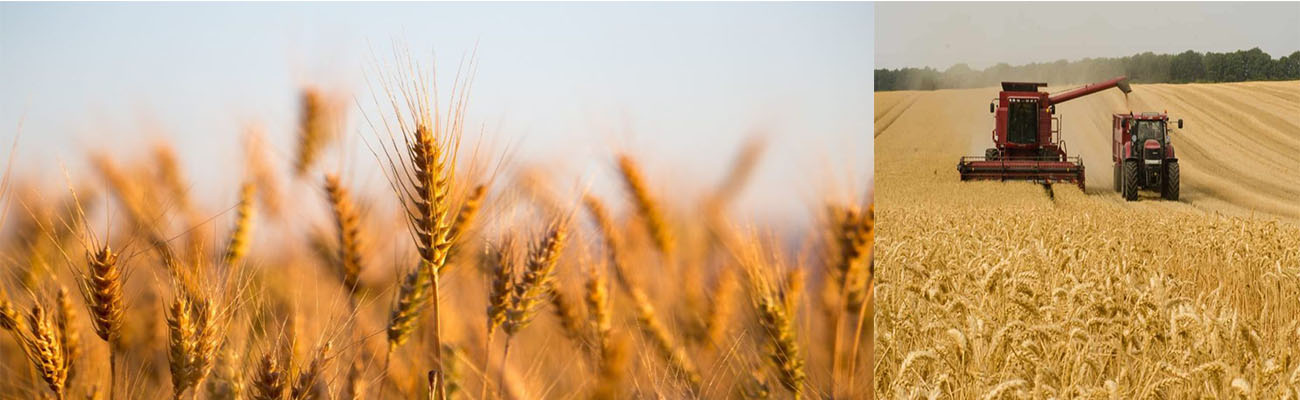
Wheat production in the United States Wheat is produced in almost every state in the United States, and is one of the most grown grains in the country. The type and quantity vary between regions. The US is ranked fourth in production volume of wheat, with almost 50 million tons produced in 2020, behind only China, India and Russia. The US is ranked first in crop export volume; almost 50% of its total wheat production is exported. The United States Department of Agriculture defines eight official classes of wheat: durum wheat, hard red spring wheat, hard red winter wheat, soft red winter wheat, hard white wheat, soft white wheat, unclassed wheat, and mixed wheat.[3] Winter wheat accounts for 70 to 80 percent of total production in the US, with the largest amounts produced in Kansas (10.8 million tons) and North Dakota (9.8 million tons). The US hard red spring wheat crop is exported to over 70 countries each year to the extent of 55%. Of the total wheat produced in the country, 50% is exported, valued at US$9 billion. History According to Ricardo Alegria, wheat was first cultivated in New Spain by afro-spanish conquistador Juan Garrido in the 16th century. Although it was first introduced to the Western Hemisphere following the discovery of the New World, wheat came to be grown in North American soil only during the colonial period.[6] During the colonial period, wheat was sown by broadcasting, reaped by sickles, and threshed by flails. The kernels were then taken to a grist mill for grinding into flour. Classification and uses[edit] Left: A variety of foods made from wheat. Right: Celis White, a wheat beer brewed in Texas. Of wheat grown in the United States, 36% percent is consumed domestically by humans, 50% is exported, 10% is used for livestock feed, and 4% is used for seedlings.Various American-style wheat beers are produced in the US. Wheat in the U.S. is grown under two major categories based on climate: winter wheat, and spring wheat. The majority is winter wheat, accounting for, on average, 75% of wheat production. Wheat may be further classified as follows:[18] [19] 1. Hard red winter wheat (HRW) with 40% production, used mainly in flour production, grown on the high plains which extends from Texas through the largest producing state, Kansas, and continuing all the way north to the Dakotas and Montana.[18][19] 2. Hard red spring (HRS) wheat (also has a sub-classification of Dark Northern Spring Wheat of high protein value, about 20% production preferred for making high quality bread is from the states of North Dakota, Montana, Minnesota, and South Dakota. 3. Soft red winter (SRW) wheat with an average production of 20% raised in the states of Ohio, Kentucky, Indiana, Washington, Oregon, Idaho, Michigan, New York, and the Southeast, the flour from this wheat is used in making cakes, cookies, and crackers.[18][19] 4. White wheat, which accounts for an average of 12.5% production in the states of Washington, Oregon, Idaho, Michigan, and New York with its flour used in making products of soup noodles, crackers, cereals, and white-crusted breads. 5. Durum wheat, the preferred variety for making pasta; grown mostly in the states of Arizona, North Dakota and Montana to an average production level of 4%. Production[edit] Center pivot irrigation on wheat growing in Yuma County, Colorado Wheat harvesting near Steptoe, Washington Sheaved and stocked wheat in Pennsylvania (1943) The United States is a major wheat-producing country, with output typically exceeded only by China, the European Union, and India. Acreage brought under wheat has, over the last several decades, varied with the wheat price. During the first decade of the 2000s, wheat ranked third among U.S. field crops in both planted acreage and gross farm income; the first two positions were held by corn and soybeans. The acreage has gone down by nearly 30% (to 48,653,000 acres in 2001, as against 60-63 million acres harvested annually in the previous years; 30 of this area is in Texas. The amount exported has also declined. The acreage reduction was dictated by the Acreage Reduction Program (ARP), which was introduced for wheat, feed grains, and cotton; and production faces pressures from multiple factors. Environmental aspects The fungus Septoria tritici can cause wheat diseases. It is generally accepted that wheat is beneficial to grow in the off season compared to other crops as its planting occurs, depending on the agro-climatic condition, in late fall or early spring. This results in reduced application of fertilizers and pesticides, and less need for irrigation, and helps in preventing soil erosion. However, some of the negative effects identified in a study conducted by the FAO are natural habitat loss due to encroachment into new lands after degraded lands are abandoned, loss of indigenous species affecting the biodiversity, and milling operation causing dust pollution. Historically, habitat conversion in the US has occurred in agropastoral land areas as in many other countries, and is considered a natural development. In the western US, habitat conversion is still an ongoing process because the subsidies provided by the government for wheat and other crops in the US have made it financially profitable to develop areas which otherwise would lie fallow; bluestem prairie is one such area. However, habitat expansion for wheat has stabilized since 2000. Grain elevator and storage facility in Enid, Oklahoma. "Queen Wheat City" is the nickname given to Enid, Oklahoma. It is also known as the "Wheat Capital" of Oklahoma and the United States for its immense grain storage capacity, and has the third-largest grain storage capacity in the world.[27] Exports[edit] Nearly 50% of the wheat produced in the US is exported, although the share of the world market has declined due to competition from Argentina, Australia, Canada, European Union, Turkey and also recently from United Kingdom, Ukraine and Russia. The exported wheat varieties are hard red winter, white wheat (about 66%), Hard Red Spring (about 50%), Soft Red Winter, and durum wheat. However, the producers continue to increase exports as in the domestic market wheat products have not been competitive in recent years.[14] One of the widely criticized export policies of the US was the PL 480 (Public Law 480), instituted in 1954, which lasted until 1969. India had a major share of about 50% in receiving this aid under it. This policy was criticized because it had damaged the export potential of many countries, in particular Australia and Canada. It was also said that this policy discouraged countries from developing their own agriculture. In India, this aid "bankrupted large numbers of Indian farmers".