 +91 9810683942
 info@akshatagro.com
+91 9810683942
info@akshatagro.com
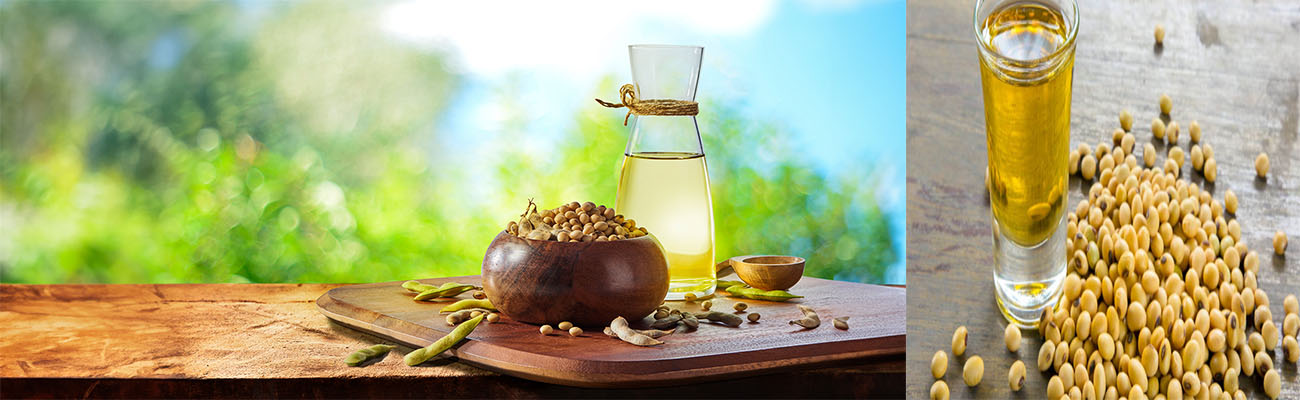
Soyabean The soybean, soy bean, or soya bean (Glycine max) is a species of legume native to East Asia, widely grown for its edible bean, which has numerous uses. Traditional unfermented food uses of soybeans include soy milk, from which tofu and tofu skin are made. Fermented soy foods include soy sauce, fermented bean paste, nattō, and tempeh. Fat-free (defatted) soybean meal is a significant and cheap source of protein for animal feeds and many packaged meals. For example, soybean products, such as textured vegetable protein (TVP), are ingredients in many meat and dairy substitutes. Soybeans contain significant amounts of phytic acid, dietary minerals and B vitamins. Soy vegetable oil, used in food and industrial applications, is another product of processing the soybean crop. Soybean is the most important protein source for feed farm animals (that in turn yields animal protein for human consumption). Etymology The word "soy" originated as a corruption of the Cantonese or Japanese names for soy sauce (Chinese: 豉油; Jyutping: si6jau4; Cantonese Yale: sihyàuh) (Japanese: 醤油, shōyu). The name of the genus, Glycine, comes from Linnaeus. When naming the genus, Linnaeus observed that one of the species within the genus had a sweet root. Based on the sweetness, the Greek word for sweet, glykós, was Latinized.The genus name is not related to the amino acid glycine. Classification The genus Glycine may be divided into two subgenera, Glycine and Soja. The subgenus Soja includes the cultivated soybean, G. max, and the wild soybean, treated either as a separate species G. soja, or as the subspecies G. max subsp. soja. The cultivated and wild soybeans are annuals. The wild soybean is native to China, Japan, Korea and Russia. The subgenus Glycine consists of at least 25 wild perennial species: for example, G. canescens and G. tomentella, both found in Australia and Papua New Guinea.[9][10] Perennial soybean (Neonotonia wightii) belongs to a different genus. It originated in Africa and is now a widespread pasture crop in the tropics. Like some other crops of long domestication, the relationship of the modern soybean to wild-growing species can no longer be traced with any degree of certainty. It is a cultigen with a very large number of cultivars. Description Like most plants, soybeans grow in distinct morphological stages as they develop from seeds into fully mature plant. Germination The first stage of growth is germination, a method which first becomes apparent as a seed's radicle emerges.This is the first stage of root growth and occurs within the first 48 hours under ideal growing conditions. The first photosynthetic structures, the cotyledons, develop from the hypocotyl, the first plant structure to emerge from the soil. These cotyledons both act as leaves and as a source of nutrients for the immature plant, providing the seedling nutrition for its first 7 to 10 days. Bhatmaas – Nepali fried soybeans Maturation The first true leaves develop as a pair of single blades.[16] Subsequent to this first pair, mature nodes form compound leaves with three blades. Mature trifoliolate leaves, having three to four leaflets per leaf, are often between 6 and 15 cm (2+1⁄2 and 6 in) long and 2 and 7 cm (1 and 3 in) broad. Under ideal conditions, stem growth continues, producing new nodes every four days. Before flowering, roots can grow 2 cm (3⁄4 in) per day. If rhizobia are present, root nodulation begins by the time the third node appears. Nodulation typically continues for 8 weeks before the symbiotic infection process stabilizes. The final characteristics of a soybean plant are variable, with factors such as genetics, soil quality, and climate affecting its form; however, fully mature soybean plants are generally between 50 and 125 cm (20 and 50 in) in height and have rooting depths between 75 and 150 cm (30 and 60 in). Soybean Chinese name Chinese 大豆 Literal meaning "large bean" showTranscriptions Southern Chinese name Traditional Chinese 黃豆 Simplified Chinese 黄豆 Literal meaning "yellow bean" showTranscriptions Vietnamese name Vietnamese alphabet đậu tương (or đỗ tương) đậu nành Chữ Hán 豆漿 Chữ Nôm 豆𥢃 Korean name Hangul 대두 (or 메주콩) Hanja 大豆 showTranscriptions Japanese name Kanji 大豆[2] Kana ダイズ showTranscriptions Beans for sale at a Supermarket in China The soybean, soy bean, or soya bean (Glycine max)[3] is a species of legume native to East Asia, widely grown for its edible bean, which has numerous uses. Traditional unfermented food uses of soybeans include soy milk, from which tofu and tofu skin are made. Fermented soy foods include soy sauce, fermented bean paste, nattō, and tempeh. Fat-free (defatted) soybean meal is a significant and cheap source of protein for animal feeds and many packaged meals. For example, soybean products, such as textured vegetable protein (TVP), are ingredients in many meat and dairy substitutes.[4] Soybeans contain significant amounts of phytic acid, dietary minerals and B vitamins. Soy vegetable oil, used in food and industrial applications, is another product of processing the soybean crop. Soybean is the most important protein source for feed farm animals (that in turn yields animal protein for human consumption). Etymology The word "soy" originated as a corruption of the Cantonese or Japanese names for soy sauce (Chinese: 豉油; Jyutping: si6jau4; Cantonese Yale: sihyàuh) (Japanese: 醤油, shōyu). The name of the genus, Glycine, comes from Linnaeus. When naming the genus, Linnaeus observed that one of the species within the genus had a sweet root. Based on the sweetness, the Greek word for sweet, glykós, was Latinized. The genus name is not related to the amino acid glycine. Flowering Flowering is triggered by day length, often beginning once days become shorter than 12.8 hours. This trait is highly variable however, with different varieties reacting differently to changing day length.[19] Soybeans form inconspicuous, self-fertile flowers which are borne in the axil of the leaf and are white, pink or purple. Though they do not require pollination, they are attractive to bees, because they produce nectar that is high in sugar content. Depending on the soybean variety, node growth may cease once flowering begins. Strains that continue nodal development after flowering are termed "indeterminates" and are best suited to climates with longer growing seasons. Often soybeans drop their leaves before the seeds are fully mature. The fruit is a hairy pod that grows in clusters of three to five, each pod is 3–8 cm (1–3 in) long and usually contains two to four (rarely more) seeds 5–11 mm in diameter. Soybean seeds come in a wide variety of sizes and hull colors such as black, brown, yellow, and green. Variegated and bicolored seed coats are also common. Seed resilience The hull of the mature bean is hard, water-resistant, and protects the cotyledon and hypocotyl (or "germ") from damage. If the seed coat is cracked, the seed will not germinate. The scar, visible on the seed coat, is called the hilum (colors include black, brown, buff, gray and yellow) and at one end of the hilum is the micropyle, or small opening in the seed coat which can allow the absorption of water for sprouting.